Wednesday, 16 April 2014

Official Google Camera app for Android hits the Play store with new features

In line with the rumor from a couple of weeks ago, Google launched a refreshed camera app for Android devices. Dubbed Google Camera, the application is now available to download in the Play store.

The most notable new feature which Google Camera app brings is called Lens Blur. It allows users to change the depth of field of a photo after its capture. A dedicated slider allows the user to change the point and level of focus.

Panorama mode has also been improved in the new app. Users can now capture panoramas in high resolution.
Photo Sphere is present too. Mobile photographers can capture 360 degree photo spheres at up to 50 megapixels.

Google Camera is available on all Android smartphones and tablets with Android 4.4 and up. You can download the app by hitting the first source link below. Feel free to drop us a line with your impressions in the comments section below.
Source 1 | Source 2 | Source 3

Saturday, 12 April 2014

Alibaba to enable fingerprint purchases for the Galaxy S5

The latest generation of devices reintroduced fingerprint recognition into mobiles, with online payment services like PayPal quickly jumping aboard to enable secure one-touch authorization for purchases.

Chinese ecommerce site Alibaba is allegedly also looking to enable mobile purchase verification using the Samsung Galaxy S5‘s fingerprint sensor, this time to the wider Asian market.
According to a report out of China, Alibaba is going to allow its third-party online payment platform AliPay to not only make payments but will also let consumers confirm product satisfaction before releasing money to the seller. This feature is set to go live this quarter.
The report also indicates that AliPay has been tested on other fingerprint-sensing devices like the Apple iPhone 5S and HTC One Max, although it is unknown whether the feature will become available to those smartphones as well.
Meanwhile, the news coincides with Samsung’s massive global launch of the Galaxy S5 today. For more on the new high-tech flagship, check out our full review.

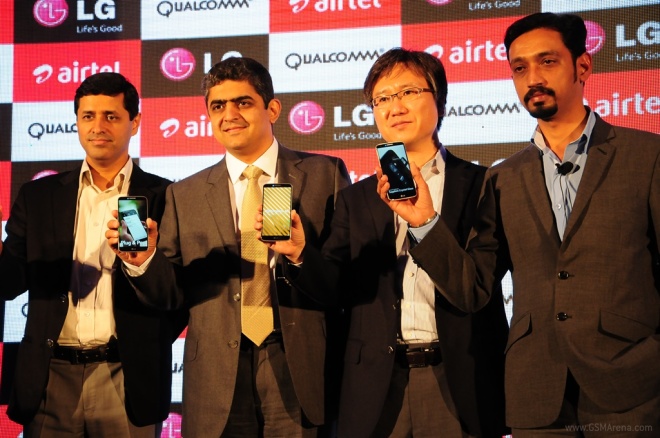
Qualcomm, LG and Airtel join forces to bring LTE experience in India

While many countries across the globe are enjoying the latest standard for wireless communication, the huge market that is India is struggling to keep up the pace with current technology. The lack of LTE enabled smartphones along with the high cost for deploying the next-generation networks has kept the country stuck on 3G.

Now, two of the biggest names in the tech industry – Qualcomm and LG have joined forces to bring the fourth generation mobile telecommunications technology experience to the consumers in the sub-continent.
India has very low cellular penetration rate and it also represents a major target for growth in the TD-LTE space. So, obviously companies like Qualcomm and LG, which are among the leaders in LTE support, want to make the most out of it before everyone else catch up.
So, what exactly are LG and Qualcomm doing in India? Both companies are hard at work pushing the LTE technology across the country. LG has launched the LTE variant of its flagship smartphone, the G2 in the country and is encouraging consumers to try the next-generation mobile internet service. Like many recent flagships LG G2 4G LTE version is also powered by Qualcomm’s Snapdragon 800 processor, which features integrated LTE.
Meanwhile, Qualcomm is already on its 4th generation LTE multimode modem and offers LTE Advance with carrier aggregation. This means that you can use your LG G2 4G LTE unit with multiple LTE carriers.
According to LG Mobile’s product and marketing head, Mr Amit Gujral – “The 4G is a much awaited and relatively new mobile telephony in India, but its many benefits will ensure its fast acceptance. 4G will become mainstream in India by the end of 2015 and LG G2 is a first step to realize the new mobility service for the Indian Consumers.”
Dr. Sandeep Sibal country manager and vice president of business development for Qualcomm India & South Asia said “This significant milestone sets a new benchmark for smartphone experiences such as superfast web browsing, high definition video streaming and console quality multiplayer gaming.”
Qualcomm in association with LG Electronics and Bharti Airtel have set up an LTE experience zone in Bangalore for you to try the blazing speed service and innumerable possibilities of 4G LTE. So, if you are around the city, then do visit the center to see the latest technology in action.

Take at Samsung’s facilities where the Galaxy S5 received its training

Every phone, smartphones included, has to pass certain tests and requirements in order to be allowed on the market. FCC is the responsible authority for the USA, TENAA for China, etc. Before any device is submitted to those government agencies though it must pass a bunch of internal tests, which are often far tougher and stricter.

Samsung has shed some light on what the Galaxy S5 test facilities look like and how it was used to make sure the flagship is as great as possible.
One of the primary concerns of every certification authority is the emitted radiation, so Samsung naturally has this room for such testing purposes. The liquid imitates human fluids, while the probe measures the radiation. The last room is where the engineers measure how a device’s radiation affects other on common electronics.


Audio testing and coverage are of great importance too. The first room tests the radios inside the phone, the second is used to test devices’ microphones, while the third is all about background noise and how the gadget’s noise canceling is handling it.

Audio quality is very important too.

The camera should also pass various tests. You can see Samsung’s employees doing shots on resolution charts, color posters, while the latter arc-like tool measure the LED flash range.

Home button is an Achilles’s heel for many phones and that’s why Samsung puts the key under extensive click torture to ensure it can survive the entire lifecycle of the smartphone.

You bet the device’s temperature is measured via thermal cameras too, so the manufacture can be sure it won’t overheat under extreme system overload.

This thing imitates static electricity, because it can kill a phone. Samsung makes sure this doesn’t happen and this is probably where lots of early prototypes have died.

Water and dust tests are also conducted. The dust test is required even on non-dust protected phones to ensure it is capable of handling the dust it will accumulate during its lifecycle.

Finally this machine drops the phones so Samsung finds their weak spots and reinforces them to make them extra tough. Samsung believes people drop their phones a few times during their lifecycle, so the manufacturer makes everything possible to make its Galaxies survive the falls.

The latest and greatest Galaxy S5, which went through each and every room in the Samsung lab is officially out there as of today. You can check our review right here.

Nokia X dual-SIM battery life test

You’ve probably noticed our in-depth review of the dual-SIM Nokia X is now live on our homepage. Now it is time to share with you the full battery benchmarks breakdown to see for yourself how the Nokia X stacks against the competition.

Nokia X is running on a very-low powered Snapdragon S4 Play chipset with a dual-core Cortex-A5 processor, but it comes with a rather modest by today’s standards 1,500 mAh battery. We didn’t expect some impressive battery performance not just because of the small battery, but also because the dual-SIM connectivity and the 4″ screen display that needs to be lit up.
Anyway, the Nokia X did start pretty well. The phone managed to last almost 12 hours of 3G calls before its battery went dead. This is close to the manufacturer’s rating of 13 hours on 2G and 10.5 hours on 3G networks.

Talk time

  • Samsung Galaxy Tab Pro 10.1 LTE 46:44h
  • Samsung Galaxy Core I8260 11:52h
  • HTC Desire 500 11:31h
  • Samsung Galaxy Premier I9260 11:30h
  • HTC DROID Incredible 4G LTE 11:25h
  • Asus PadFone 2 11:20h
  • Nokia X dual-SIM 11:13h
  • HTC DROID DNA 11:07h
  • Samsung S8600 Wave 3 11:07h
  • LG Optimus L9 P760 11:07h
  • HTC One SV 11:07h
  • HTC Windows Phone 8X 11:07h
  • Pantech Burst 4:46h
Nokia X did quite poorly on web browsing. Its battery packed enough juice to last only 5 minutes short of 5 hours. This is far from great and the Nokia X web browser probably needs some further tweaking. During the time we spent on the review Nokia pushed two updates already for the browser, so hopefully it will get better in time.

Web browsing

  • Sony Xperia C 12:45h
  • Sony Xperia acro S 5:16h
  • LG Optimus G E975 5:15h
  • HTC Rhyme 5:08h
  • Samsung I9103 Galaxy R 5:07h
  • LG Optimus L9 P760 5:02h
  • Nokia X dual-SIM 4:55h
  • Sony Ericsson Xperia pro 4:50h
  • LG Optimus Vu F100S 4:49h
  • LG Nexus 5 4:46h
  • HTC Vivid 4:46h
  • Samsung Galaxy Ace Duos S6802 4:45h
  • Samsung Galaxy Nexus I9250 3:01h
Finally, our last test measures the battery endurance during looped video playback. Nokia X’s battery dropped down to the critical 10% after 6 hours and 10 minutes. This seems about right given the phone’s hardware and supplied battery. You’ll be able to enjoy a few movies during some long trips, though you probably won’t have much charge remaining when you arrive.

Video playback

  • LG G Flex 19:57h
  • LG Optimus Vu F100S 6:23h
  • Samsung I9103 Galaxy R 6:21h
  • Nokia Lumia 920 6:19h
  • Sony Xperia Z1 6:12h
  • HTC Sensation XL 6:12h
  • Nokia X dual-SIM 6:10h
  • LG Nexus 5 6:06h
  • Samsung Galaxy Pocket S5300 6:06h
  • Samsung i927 Captivate Glide 6:04h
  • Sony Xperia ion LTE 6:03h
  • Samsung Galaxy Nexus I9250 6:02h
  • Nokia Lumia 710 3:27h
The Nokia X features dual-SIM connectivity with dual-standby support. And that probably explains why the standby performance, while not bad, isn’t among the best we’ve seen. Thus the final endurance rating means the phone won’t last more than 38 hours if you are using it for an hour of 3G calls, web browsing and video playback each day.

If you are opting for the single-SIM version of the phone, you’ll probably get a few hours more due to better standby efficiency.

Samsung Galaxy S5 battery life test

The Samsung Galaxy S5 is bound to become one of the hottest selling handsets and so it must undergo heavy scrutiny. Battery life is an everyday worry, especially with bigger screens and faster chipsets.

The Galaxy S5 screen isn’t much bigger than that of its processor (5.1″ vs. 5″), but it is brighter. The Snapdragon 801 chipset should also offer a big performance boost over the Snapdragon 600 of last year.
Samsung has enabled a couple of battery saving features ranging from practical to extreme. The Ultra Power Saving mode disables most functionality and shows a simplified black and white homescreen.
We didn’t use those features for the test as they are for emergencies when the last few percent of the battery have to hold out for hours before you can charge the phone again.
The Galaxy S5 lasted over 21 hours of 3G calls. That puts it ahead of the HTC One (M8) by an hour, three ahead of the Galaxy Note 3, but well behind the impressive 25 hour result of the LG
G2.

Talk time

  • Samsung Galaxy Tab Pro 10.1 LTE 46:44h
  • Huawei MediaPad 7 Vogue 22:16h
  • HTC One Max 22:13h
  • Nokia Lumia 1320 22:13h
  • Samsung Galaxy Core LTE 22:13h
  • Nokia Lumia 1020 22:13h
  • Samsung Galaxy S5 21:20h
  • Motorola RAZR MAXX 21:18h
  • LG Optimus G Pro E985 20:45h
  • Sony Xperia Z1 Compact 20:42h
  • Motorola DROID RAZR MAXX 20:24h
  • Motorola RAZR i XT890 20:07h
  • Pantech Burst 4:46h
The Samsung Galaxy S5 has a 2,800mAh battery, a 200mAh bump from the S4. The LG G2, for comparison, has a 3,000mAh battery. The Samsung phone lasted nine and half hours of browsing the web over Wi-Fi, beating the One (M8) by half an hour but again lagging behind LG G2.

Web browsing

  • Sony Xperia C 12:45h
  • Samsung Ativ Odyssey I930 9:54h
  • Samsung I9190 Galaxy S4 mini 9:47h
  • Samsung Galaxy Note 3 Neo 9:43h
  • Alcatel Hero 9:40h
  • Samsung Galaxy Core LTE 9:37h
  • Samsung Galaxy S5 9:36h
  • LG G Pro 2 9:31h
  • LG G Flex 9:31h
  • Samsung Galaxy Tab Pro 10.1 LTE 9:16h
  • Motorola RAZR MAXX 9:12h
  • HTC One (M8) 9:06h
  • Samsung Galaxy Nexus I9250 3:01h
The HTC One (M8) does come out ahead of the Galaxy S5 in the video playback time, but by just a smidge – both new flagship lasted 11 hours. Even the LG G2 failed to pull ahead by much here.

Video playback

  • LG G Flex 19:57h
  • Samsung I9500 Galaxy S4 11:29h
  • Samsung Galaxy Note II N7100 11:27h
  • Oppo N1 11:15h
  • BlackBerry Q10 11:15h
  • HTC One (M8) 11:14h
  • Samsung Galaxy S5 11:05h
  • Apple iPhone 5s 10:31h
  • Apple iPhone 5 10:12h
  • HTC First 10:03h
  • HTC One 10:02h
  • Sony Xperia Z1 Compact 10:01h
  • Nokia Lumia 710 3:27h
Compared to last year’s Galaxy S flagship, the Galaxy S5 manages three hours more of talking and two hours more of web browsing, but an hour less of video playback. The Galaxy Note 3 with its 5.7″ screen 3,200mAh battery was behind the S5 in everything but video.
Efficient standby on the new phone results in an Endurance rating of 72 hours, which puts it between the Galaxy S4 and the Note 3.

Even without Samsung’s advanced power saving modes, the Galaxy S5 offers excellent battery life. With moderate usage you can get three full days of usage before you need to charge your phone. Don’t forget to check our Battery life test page if your phone usage differs from the standard one hour of each per day we use to calculate the Endurance rating.

Friday, 11 April 2014

Microsoft pulls support plug on Windows XP and Office 2003

Dating from way back in October of 2001 Windows XP has been Redmond’s most highly regarded OS until Windows 7 hit in October 2009 and for many traditionalists even after that.

And now after 13 years of service the OS is finally getting dropped by Microsoft, which has issued its last security update to the OS yesterday and will not issue more. In its statement Microsoft urges users to either upgrade their current PCs with a more recent Windows install or altogether buy a new machine (the company even has a link to latest Windows 8 machines readily awaiting your click).
The support halt will affect Office 2003 as well so if you’re running that you might have to
consider the newer Office versions or alternatives. And while the lack of support doesn’t mean your Windows XP-powered rig will stop working it does mean you’re much more vulnerable to cyber hacking and attacks as many hackers will try to exploit the lack of security patches concerning newer online threats.
Microsoft issues security patches every second Tuesday of the month (dubbed Patch Thursday) and security experts expect hackers to try and utilize next Patch Thursday (May 13) as a way into PCs. Currently only a third of the world’s 2.2 million ATMs have been updated with newer than Windows XP software and appear prime candidates for hacking.
Just in February Windows XP was running on almost 30% of all PCs, dwarfed only by Windows 7′s 47% reach. Now XP is said to occupy around 25%, which is still pretty impressive.
Windows XP loading